
Sales rows per month
576.51,153 ÷ 2
RETAIL · DIGITAL COMMERCE · AI GROWTH
Implemented · all described modules · owner confirmed
Business diagnostics, GTM, commerce, equipment selection, CRM, inventory and loyalty — organised around one customer need.
Our role with HONOR Group is AI Growth Digital Partner. We work on the AIStart360 platform.
Client case study. Marina and AIStart360 contribute to digital development and testing growth directions; this is not a claim of ownership of HONOR.
Current status
No open funding round has been announced.
HONOR / GROWTH DASHBOARD
An implemented ecosystem connecting gear selection, CRM, inventory and repeat purchases. The owner supplied two source metrics; derived values are calculated below.
Downloads are available to registered users after sign-in.
A baseline from the monitoring workbook covering two months. Averages use January and February 2026 totals, with no extrapolation to a third month.
1,153 ÷ 2
39,431,102 ₸ ÷ 2
The sales count represents product-level accounting rows, not unique orders or buyers. This baseline therefore does not establish order growth or a change in average order value.
This is a separate metric with no exact three-month period dates supplied. Order growth is not directly compared with the sales rows in Point A.
Compared with the same period a year earlier
Three months · exact dates not specified
3,000 × 180,000 ₸
Additional orders × average order value, assuming the additional orders have that same average value. This is a calculation, not verified incremental revenue.
A reverse calculation from 3,000 additional orders. The conversion rates below are editable assumptions, not observed HONOR rates. Visits and enquiries are modelled incremental volumes, not total business traffic.
Stage diagram: widths are schematic. Counts and conversions are calculated from assumptions.
For the next cycle, assume repeat orders equal the selected share of the 3,000-order increase, at the same average value. This is an additional scenario, not a breakdown of the observed 3,000 orders. Repeat orders and cost per additional order have not been measured for this case.
An even allocation of the total increase, not observed monthly performance.
Point A uses the January–February 2026 monitoring workbook. Order growth, average order value and store count are owner reported. The funnel and next sales cycle use the stated assumptions. Returns, cancellations, VAT, cost of goods and operating expenses are not modelled. The data do not establish AI’s causal contribution. LTV, ROMI, profit and observed retention require further source data.

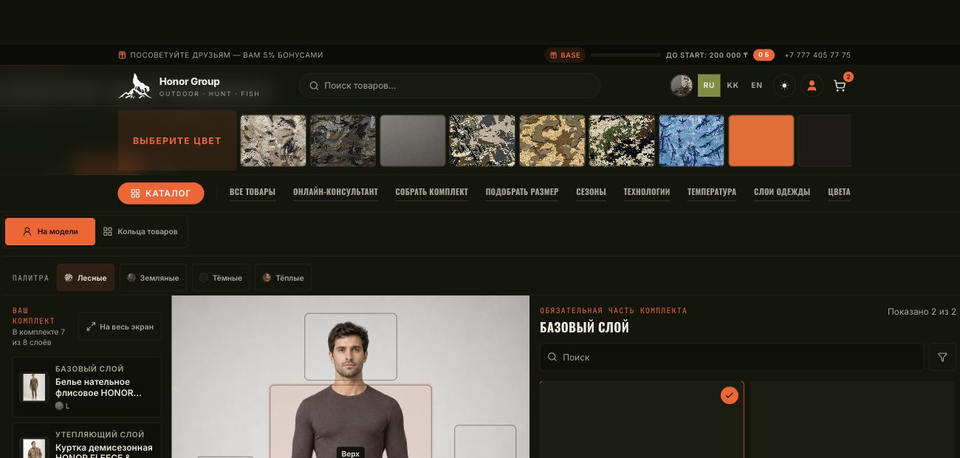
All described modules are implemented according to the owner. Delivered capabilities, supplied metrics and the calculation model are shown separately.
Need-based selection, kit building and order handoff are implemented.
CRM, AIStart360 inventory and Honor Club operate within the described scope according to the owner.
Over three months versus the equivalent prior-year period. Owner-reported figures; average order value is KZT 180,000.
GRI × GTM → journey → data → module → verification, without universal performance promises.
Open a module for its problem, scenario, technology and validation criterion.
Connect a need to the assortment.
Individual items may not form a compatible kit.
Move an enquiry towards a choice and next action.
Make the next action accountable.
Use authoritative product and fulfilment facts.
Turn a first purchase into an ongoing relationship.
Implemented architecture: the site, CRM and AIStart360 inventory system. Completion is owner confirmed.
Customer card, kit, order, bonus balance and tier.
Enquiry, deal, owner, stage and next action.
SKU, prices, stock, reservations, shipments and returns.
products · prices · stock · fulfilment · returns
orders · agreed customer data · discounts · loyalty snapshots
implemented end-to-end flow · owner confirmed
The described implemented scope includes JSON API and webhooks, stock and reservation sync, retries, reconciliation, cancellations and returns. Implementation is owner confirmed.
Bonus accrual and spending are scoped to website orders. Kaspi and Ozon are excluded; complete offline coverage is not claimed.
Outdoor purchases begin with intended use: activity, season, temperature and fit. The transformation connects that need to the assortment, a clear offer and fulfilment.
D2C, stores, B2B and marketplaces need shared product definitions and clear ownership of the next action.
The HONOR diagnosis examines product and demand, business model, channels and funnel. The Key Directions document connects inventory, consultation, the owned website, stores, B2B and marketplaces to assortment, bundling and repeat purchases.
Three management priorities shape the digital system: retain the enquiry, help customers choose a coordinated kit and continue the relationship after purchase. GTM priorities guide delivery order; financial plans and forecasts are not presented as achieved outcomes.
Define the customer job → structure product knowledge → design the buying journey → connect channels and operations → test scenarios → improve using evidence.
AI can interpret needs, explain choices and prepare next actions. Product facts, prices, availability and loyalty rules remain controlled by authoritative systems and accountable people.
The implemented journey connects the storefront to purchase: catalogue, product page, cart, checkout and fulfilment handoff. Customers can begin with a product, usage conditions or a kit.
The site, CRM and AIStart360 inventory system form one operating flow. Completion is owner confirmed; actual customer and payment records are not exposed in this case.
Need-based selection is implemented: activity → season and temperature → suitable layers → kit → order. AI assistance and product knowledge support the journey, while product facts, prices and availability rely on the inventory system.
The owner confirms the selector, kit builder and order handoff are implemented. Recommendation quality and AI’s specific contribution to conversion require separate metrics.
The Instagram sales and selection bot is implemented within the enquiry workflow. Customers start in a familiar channel and their request and context pass to CRM for the team to continue.
The owner confirms implementation of the bot, enquiry handoff and manager workflow. Customer conversations and personal data remain private.
CRM is implemented for enquiries, deals, stages and ownership. Enquiry source and the next action connect to order processing.
It preserves context across channels and supports follow-up after purchase. Implementation is owner confirmed; the public case presents the workflow without exposing customer records.
The AIStart360 inventory system is implemented within HONOR for product data, SKUs, prices, stock and fulfilment facts. The site and CRM use these facts in the order journey.
The owner confirms the described order handoff, reservations, shipments and returns are implemented. The architecture separates customer workflow, product facts and loyalty rules.
Honor Club is implemented with customer cards, Start / Nomad / Legend tiers, cashback and bonus rules linked to purchase and fulfilment. The site manages loyalty rules and the AIStart360 inventory system supplies fulfilment facts.
The programme’s specified scope remains: accrual and spending apply to website orders; Kaspi and Ozon are excluded. Implementation does not imply coverage of excluded channels.
The described end-to-end journey is implemented: consultation → selection → kit → site → CRM → fulfilment → loyalty. The team continues with customer intent and order composition across handoffs.
Implementation is owner confirmed. Marketplace identity limits and excluded-channel rules remain; implementation does not imply unrestricted access to third-party customer data.
Additional paid orders: +3,000 over three months versus the equivalent prior-year period, as reported by the owner.
Average order value: KZT 180,000 for the same period, confirmed by the owner as an actual metric.
Calculated additional-order equivalent: 3,000 × KZT 180,000 = KZT 540 million, assuming the additional orders have that same average value. This is an illustrative calculation, not published revenue.
Implemented ecosystem: digital selection, CRM, inventory, Honor Club and Digital Experience Center. Funnel volumes, conversion and repeat purchases are modelled scenarios; AI’s separate causal contribution has not been established.
Digital Experience Center is implemented across all eight described zones: video wall, digital catalogue, video consultation, fitting, ordering, packing, pickup and content. Digital selection connects to the physical experience.
The owner confirmed completion on 22 October 2026. The case shows each zone’s purpose and place in the customer journey.
The 90-day implementation cycle is complete according to the owner: journey mapping, product knowledge, an AI product advisor, a phygital layer, CRM personalisation, analytics and a Retail Playbook form a working system.
The next cycle uses controlled experiments: hypothesis → AI intervention → human outcome → business metric → observation → learning. The supplied overall growth figures do not measure each experiment’s individual effect.
Development follows six levers: faster sales, retention, basket value and frequency, partner channels, referrals and cash resilience. AI can analyse de-identified loss reasons, draft explanations and identify suitable follow-up signals.
Each hypothesis requires usefulness and quality checks. Customer promises, pricing and returns need explicit rules and human control.
Reuse the logic rather than a stack of tools: find a journey gap, define authoritative data, select one scenario, connect accountable teams and verify the result.
An initial conversation defines the problem and pilot boundaries. Tools follow the workflow; effect and timeline require diagnosis.
We welcome CRM and integration developers, commerce, AI, RetailTech, CX and analytics specialists. Share a capability, relevant work and a concrete contribution.
As AI Growth Digital Partner, we connect the business problem, AIStart360 method and delivery. Scope, payment and accountability are agreed separately; an enquiry is not a contract.
Journey demonstration · not live order statuses
One customer · shared basket · fitting and purchase history · 12 stores
On the way, the customer selects gear in the online store. Models, size, colour and camouflage remain in the basket and profile.
| Implemented flow | Delivered capability | Quality control | Scope | Further development |
|---|---|---|---|---|
| Selection → kit | Implemented · owner confirmed | Test composition through checkout | Within the stated channels and access rules | Improve using de-identified data and separate measurements |
| Instagram → CRM | Implemented · owner confirmed | Verify source, context and handoff | Within the stated channels and access rules | Improve using de-identified data and separate measurements |
| Site → AIStart360 inventory system | Implemented · owner confirmed | Test order, reserve, retries and failure | Within the stated channels and access rules | Improve using de-identified data and separate measurements |
| Return → loyalty | Implemented · owner confirmed | Test full and partial returns without duplication | Within the stated channels and access rules | Improve using de-identified data and separate measurements |
| Marketplaces → loyalty | Channel exclusions implemented | Verify excluded-channel rules | Kaspi and Ozon remain excluded from loyalty accrual | Improve using de-identified data and separate measurements |
All eight Digital Experience Center zones are implemented according to the owner.
Video and seasonal scenarios help customers start choosing.
Zone implemented · owner confirmed on 22 October 2026.
An on-screen catalogue supports exploration and comparison.
Zone implemented · owner confirmed on 22 October 2026.
An expert helps inspect a product remotely.
Zone implemented · owner confirmed on 22 October 2026.
Fitting connects sizes, QR context and kit composition.
Zone implemented · owner confirmed on 22 October 2026.
A manager continues selection and prepares the order.
Zone implemented · owner confirmed on 22 October 2026.
Preparation, quality checks and shipping handoff.
Zone implemented · owner confirmed on 22 October 2026.
Pickup, exchange and return form one service flow.
Zone implemented · owner confirmed on 22 October 2026.
Reviews and demonstrations turn product knowledge into content.
Zone implemented · owner confirmed on 22 October 2026.
1Hypothesis: who benefits, and in which task?
2AI intervention: what changes?
3Human outcome: what can the person accomplish?
4Business metric: what transition or outcome is observed?
5Result: actual observation, date and sample. Not yet populated.
6Learning: continue, change or stop?
Implementation is complete according to the owner. Further experiments can isolate conversions, retention and AI contribution; dashboard scenarios do not replace those measurements.
LET’S BUILD SOMETHING USEFUL
Consultation, AI pilot, technology partnership or expert contribution — start with your challenge.